


Why Small Towns Need Digital Waste Systems More Than Metro Cities

When people talk about “smart waste management,” the image that usually comes to mind is a metro city—glass buildings, GPS-tracked trucks, and big dashboards glowing in command centers. Smaller towns are rarely part of this picture.
That’s a mistake.
In reality, small towns and municipalities need digital waste systems far more urgently than metro cities. Not because their problems are bigger—but because their margins for error are smaller.
1. Small Towns Run on Thin Buffers
Metro cities survive inefficiency. They have larger budgets, layered departments, backup contractors, and political attention that forces quick fixes when something breaks.
Small towns don’t.
A few missed collection days, an absent sanitation worker, or an untracked fuel expense can disrupt the entire system. There is no redundancy. When one link fails, everything feels broken.
Digital systems create
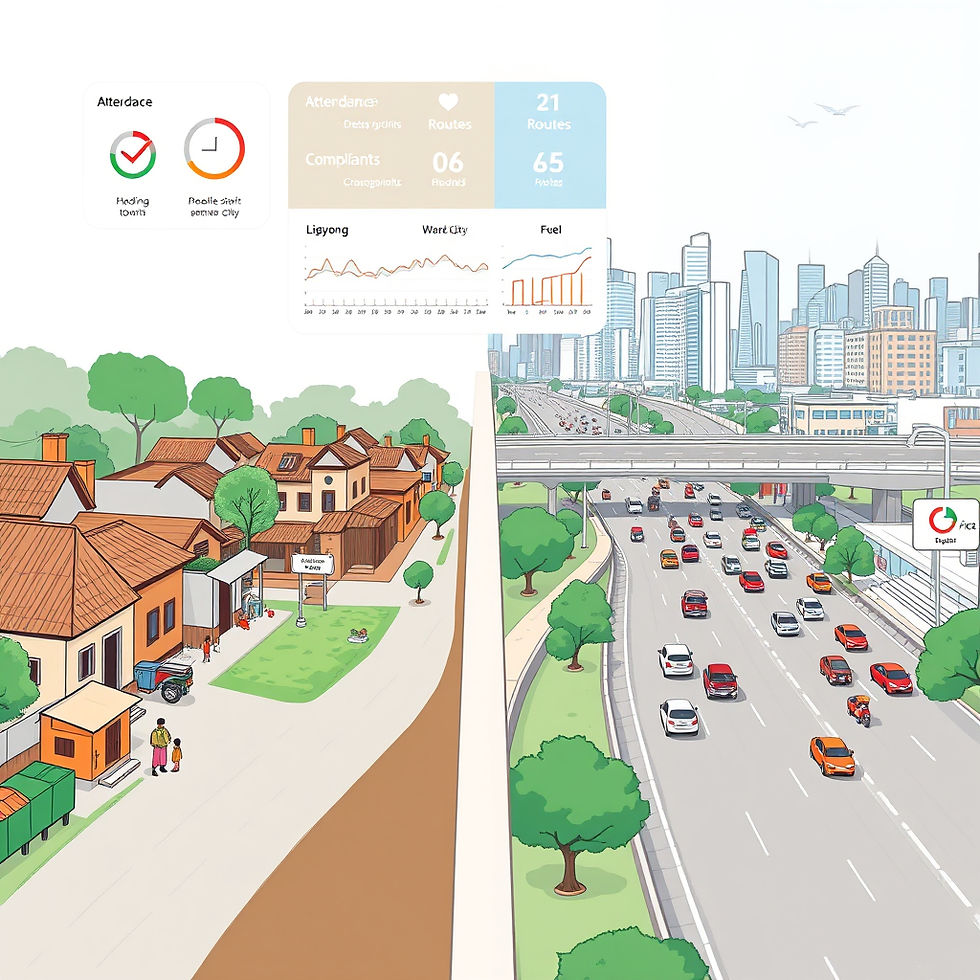
operational buffers—not by adding staff or vehicles, but by making daily work visible. Attendance, routes, and complaints stop being assumptions and start becoming data.
2. Manual Systems Hurt Small Towns More
Paper registers, verbal reporting, and end-of-month summaries are common in smaller municipalities. They feel simple and familiar, but they come with hidden costs:
Attendance marked without verification
Routes completed on paper but not on ground
Complaints lost between departments
Delays discovered weeks later, not today
Metro cities can absorb this chaos. Small towns cannot.
A digital platform replaces guesswork with daily clarity. When work is tracked in real time, problems surface early—while they are still cheap to fix.
3. Fewer People Means Higher Accountability Pressure
In small towns, everyone knows everyone. A missed collection is not an abstract KPI—it’s a phone call to the ward office, the chairman, or the commissioner.
This social proximity increases pressure on officials but doesn’t give them better tools.
Digital waste systems protect both citizens and officers. Data becomes a neutral truth. Decisions are based on what happened, not who said what. Accountability shifts from blame to process.
4. Budget Constraints Make Efficiency Non-Negotiable
Small towns operate with limited funds. Every extra trip, idle vehicle, or fuel mismatch directly impacts the budget.
This is exactly where digital systems shine.
Tracking routes prevents duplication. Monitoring fuel exposes leakage. Attendance validation stops ghost entries. Complaint analytics shows where resources are actually needed.
Efficiency is not a “nice to have” for small towns. It is survival.
5. Digital Systems Reduce Dependence on Individuals
Many small municipalities depend heavily on a few experienced staff members. When they are absent, transferred, or retire, systems collapse.
Digital platforms turn institutional memory into shared data. Processes live in dashboards, not in people’s heads. New staff can understand operations quickly, without starting from zero.
This continuity is crucial for long-term stability.
6. Small Towns Can Move Faster Than Metros
Ironically, small towns have one big advantage: fewer layers.
Decisions are quicker. Teams are smaller. Change faces less resistance. A digital system can be adopted faster and used more consistently than in large bureaucracies.
With the right platform, small towns can leapfrog metros—not by copying their scale, but by mastering control.
The Real Question Isn’t “Can Small Towns Go Digital?”
It’s this:
How long can they afford not to?
Digital waste management is not about being “smart” or modern. It’s about seeing what’s happening today, fixing it before it escalates, and using limited resources wisely.
For small towns, digital systems aren’t an upgrade.
They’re the foundation for stability, trust, and sustainable growth.
Comments