


Digital Transformation of Municipal Sanitation From Registers to Real Time Field Data

Sanitation departments run on daily action. Waste must be collected, streets must be swept, complaints must be resolved, vehicles must stay on route, and sanitation workers must be deployed without delay. For Urban Local Bodies in India, this work now needs more than paper registers and end-of-day reports. It needs accurate, timely, and verifiable operational data.
Traditional systems create familiar problems. Registers get updated late. Spreadsheets are maintained ward by ward, often in different formats. Duplicate records make it hard to know the actual number of households, properties, workers, or vehicles. Field activities are difficult to verify. Missed door-to-door waste collection can remain invisible until complaints rise. Supervisors spend valuable time calling teams, checking registers, and reconciling reports instead of improving service delivery.
This is where municipal digital transformation is changing sanitation administration. Mobile-based apps, centralised digital records, GPS tracking, dashboards, complaint management tools, and sanitation analytics are helping municipalities move from delayed reporting to real-time monitoring.

Moving from paper records to digital records
The first step in sanitation digitization is building reliable digital records. Many ULBs still manage key information across registers, files, Excel sheets, and local ward-level lists. These records may cover properties, households, waste generators, sanitation workers, vehicles, bins, routes, and complaints.
When this data is digitised, municipal sanitation management becomes easier to maintain and review. A digital system can store:
Property and household details linked to wards and zones
Door-to-door waste collection points
Worker attendance and duty allocation
Vehicle details, routes, and trip records
Complaint records with status updates
Bulk waste generators and commercial establishments
Service history for each area
Digital records reduce duplication and make searching faster. If a property changes use from residential to commercial, the record can be updated in one place. If a household is missed during collection, supervisors can check the service history instead of relying only on memory or handwritten notes.
For administrators, this creates a stronger base for planning. Property mapping can help identify uncovered areas, informal settlements, new layouts, and high-waste zones. Better records also support user fee collection, route planning, staff allocation, and compliance reporting.
Capturing data at the field level
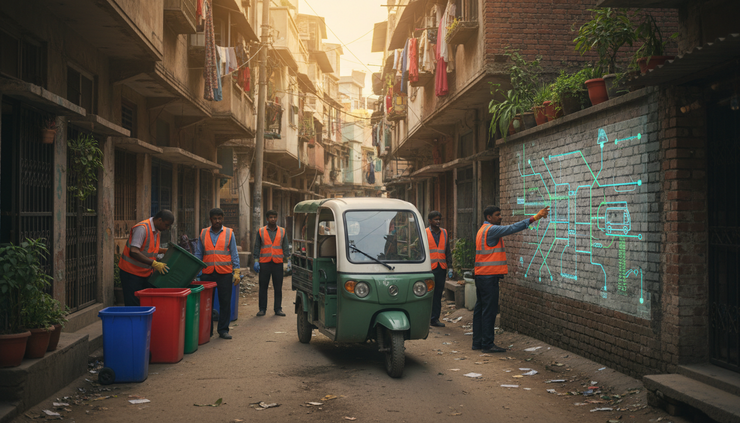
Digital waste management becomes useful when data comes directly from the field. Mobile apps allow sanitation workers, supervisors, and vehicle teams to record activities as they happen.
For example, a door-to-door waste collection team can mark collection points on a mobile device. A supervisor can upload a photo of a cleared garbage vulnerable point. A vehicle driver can record trip start and end details. A complaint resolution team can update the status from the location itself.
This field data is more reliable than reports prepared much later. It reduces the gap between what happened on the ground and what appears in municipal records.
Common field-level functions include:
Attendance marking for sanitation workers
Collection updates for households and establishments
Geo-tagged photos of work completed
Route completion tracking
Bin lifting records
Complaint closure with location proof
Vehicle movement logs
For ULBs, the value is clear. Field data helps detect missed services, delayed routes, repeated complaints, and areas needing more staff or vehicles.

Using GPS tracking for real-time monitoring
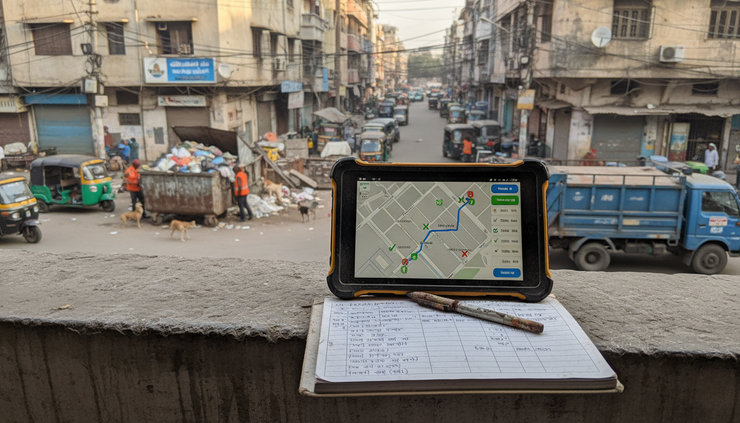
GPS tracking has become a key part of waste collection monitoring. When collection vehicles are tracked, supervisors can see whether routes are being followed, where delays occur, and whether all assigned areas receive service.
This does not mean monitoring only for control. Good GPS-enabled systems help teams solve practical problems. If a vehicle breaks down, the nearest available vehicle can be redirected. If a route regularly takes longer than expected, the municipality can review road conditions, collection load, or route design. If a complaint comes from a missed lane, the dashboard can show whether the vehicle passed that point.
Real-time monitoring also supports transparency. Municipal officers can review ward-level performance without waiting for paper reports. Commissioners can see broader service trends across zones. Field supervisors can respond faster during festivals, rains, public events, or seasonal waste peaks.
Connecting complaints with operations
Complaint management is often treated as a separate function, but it should connect directly with sanitation operations. A citizen complaint about missed waste collection, open dumping, drain cleaning, or street sweeping should not remain only as a ticket in a register.
With ULB software, complaints can be linked to teams, wards, locations, and service categories. Each complaint can have a clear status, such as assigned, in progress, resolved, or reopened. Field staff can upload proof of action. Supervisors can check ageing complaints and repeated issues in the same area.
This helps municipalities move from reactive complaint handling to pattern-based improvement. If many complaints come from one route, the issue may be route planning. If complaints repeat near a market, the area may need more frequent collection or better bin placement.
Turning dashboards into decisions
Dashboards are useful only when they help people make better decisions. A good sanitation dashboard should not overload officers with charts. It should show what needs attention.
Useful dashboard indicators may include:
Daily waste collection coverage
Missed collection points
Vehicle route completion
Worker attendance
Pending and resolved complaints
Ward-wise performance
Repeat complaint locations
Waste collection trends over time
Sanitation analytics can help identify weak points in municipal operations. For example, data may show that two wards have similar population sizes but very different complaint volumes. Another ward may show regular vehicle delays on a specific route. A market area may generate more waste on weekends. These patterns help departments plan staff, vehicles, timing, and supervision more effectively.
The aim is not to replace field knowledge. Experienced sanitation officers and supervisors understand their city deeply. Digital systems add a shared, current view of operations so decisions are based on both experience and evidence.
What ULBs should keep in mind during implementation
Technology alone cannot improve sanitation. Municipalities need a practical rollout plan.
Start with clean master data. If property, ward, worker, and vehicle records are inaccurate, reports will also be unreliable. Train field teams in simple workflows. Mobile apps should be easy to use in local working conditions, including low connectivity areas. Supervisors should review data daily, not only at month end.
ULBs should also define responsibilities clearly. Who updates property records? Who approves complaint closure? Who reviews GPS alerts? Who checks dashboard exceptions? Clear rules prevent digital systems from becoming another layer of paperwork.
A phased approach often works best. Begin with one or two wards, test field workflows, review data quality, and then scale across the city. This builds confidence among sanitation workers, supervisors, and administrators.
The shift is operational, not only technological
The real value of digital sanitation is better service delivery. When records are centralised, field data is captured on time, vehicles are tracked, and complaints are linked to action, municipalities gain clearer control over daily work.
For Indian urban local bodies, digital records, GPS-enabled monitoring, mobile field reporting, and sanitation analytics can reduce delays and improve accountability. They can also help officers plan resources with more confidence.
The move from registers to real-time field data is not about abandoning local knowledge. It is about giving sanitation teams better tools to see, verify, and improve the work they already do every day.
Comments